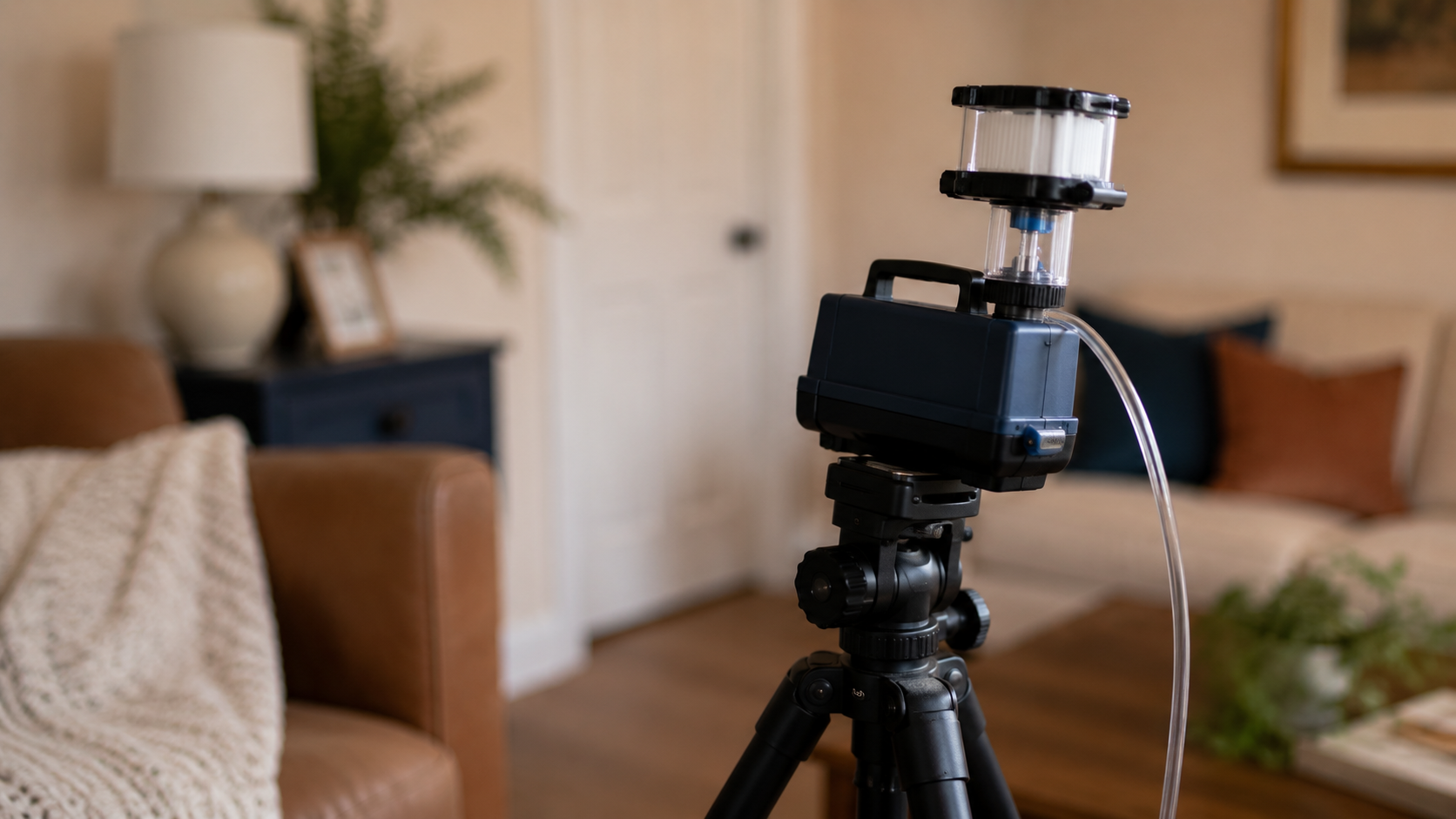
What we test for, and how
A real mold test is more than a sniff in the doorway. When we test your home, we do four things in parallel:
- Visual evaluation of every accessible space - basement, crawl space, attic, behind washer/dryer, around toilets, under sinks, around windows.
- Moisture mapping with calibrated pin and pinless meters. We read current moisture in framing, drywall, subfloor, and trim. Wet wood doesn't always look wet.
- Thermal imaging to find hidden cold/wet zones behind finished surfaces.
- Sampling - air, surface tape lift, bulk material, or ERMI dust when warranted. Every sample goes to an accredited third-party lab.
You get a written report with photos, moisture readings, and lab-verified spore counts. We tell you what we found, what we did not find, and what to do about it.
Sample types we collect
- Air samples (spore traps) - 75 liters of air across a microscope slide. Read at the lab against an outdoor control sample. Gives you a spore count per cubic meter, broken out by genus.
- Surface tape lifts - for visible growth on a hard surface. Confirms mold versus dust, soot, or staining.
- Bulk samples - a small piece of the material itself (drywall, insulation, carpet). Used when we need to confirm the material is contaminated.
- ERMI - settled dust analysis when air sampling isn't catching a problem you're confident is there.
- Post-remediation clearance - independent testing after remediation. We recommend a third party for this step.
What you get
A plain-English report you can hand to a doctor, an insurance adjuster, a buyer's agent, or a landlord. Raw lab data included. Our interpretation included. Recommended next steps included.
Clearance testing - the proof step
Clearance testing is what proves a remediation actually worked. It's the air sample taken AFTER the source has been removed, with containment still up, run against an outdoor control. A passing clearance is the document that lets you (and your insurance, and your buyer) close the file with confidence.
What clearance proves
- Spore counts inside the work zone are at or below outdoor baseline (so the work didn't just kick spores around the room - it removed them)
- No marker species above incidental levels (no Stachybotrys, no indoor-marker Aspergillus or Penicillium in concentrations that suggest indoor source)
- The work was independently verified - the lab letterhead is the third party's, not ours
What a clearance report actually looks like
A real clearance report is 4-6 pages:
- Cover page - your address, date sampled, technician name + IICRC certification number, lab name + accreditation
- Sample summary - what was sampled (air / surface / dust), how many samples, where each one was taken
- Lab data tables - species and spore counts per sample, with method codes
- Outdoor control comparison - the actual numbers side-by-side with outdoor baseline
- Pass/fail determination - in plain English with the reasoning
- Photos - of the cleared area, often with sample-collection-in-progress shots
If your clearance report doesn't include the outdoor control comparison, it's incomplete. Push back.
When clearance is required vs. recommended
- Required: Any IICRC S520-compliant remediation. Required by most insurance carriers paying for the work. Required by most real-estate transactions where mold was an issue.
- Recommended: Even when not required, the report is a document you keep forever. If the issue recurs in 5 years, the clearance report establishes the baseline.
What if clearance fails
Rare (under 1% of our jobs), but here's how it works: we don't bill you for the failure. We extend the dry-out, re-clean if needed, re-test until it passes. Built into the price.