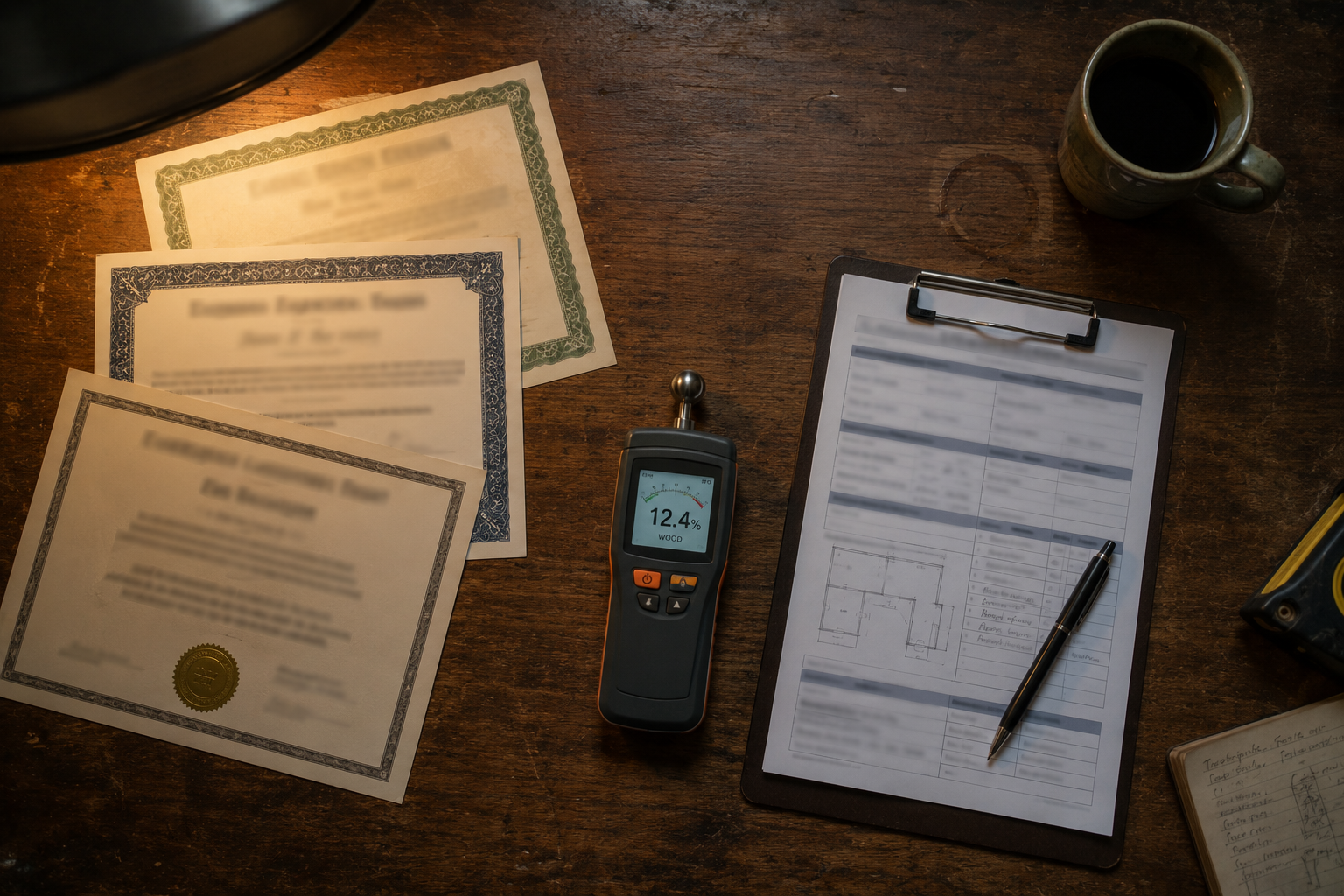
The credentials that actually matter
Mold remediation is one of the least-regulated trades in the country. Anyone with a shop vac and a logo can call themselves a remediator. The credentials that filter the real operators from the cosplay are:
IICRC certifications
We hold the certifications that the restoration industry treats as the floor for serious work:
- Water Damage Restoration Technician (WRT) - IICRC's foundational water-damage credential
- Applied Microbial Remediation Technician (AMRT) - the mold-specific certification, covering containment, removal, and clearance
- Health & Safety Technician (HST) - required for working in environments with PPE and exposure controls
We follow the ANSI/IICRC S520 Standard for Professional Mold Remediation on every job - the national standard governing containment, removal, drying, and verification.
Licensing + insurance
- Idaho contractor registration - active
- Wyoming contractor registration - active
- General liability insurance - current; certificate provided on request before any work begins
Standards we work to
| Standard | What it covers |
|---|---|
| ANSI/IICRC S520 | Mold remediation - containment, removal, verification |
| ANSI/IICRC S500 | Water damage restoration - drying, materials handling |
| ANSI/IICRC S540 | Trauma & crime scene cleanup (for biohazard-adjacent mold) |
| EPA Mold Remediation in Schools & Commercial Buildings | Reference document for public-building work |
What you should ask any mold contractor
If you're evaluating someone else (including us), use this list:
"Are you IICRC certified? In what specifically?" AMRT or WRT alone isn't enough for full-scope work. WRT + AMRT is the minimum for credible mold remediation.
"Do you follow S520?" If the answer is "what's S520?" - that's your answer.
"Do you collect pre-remediation and post-remediation air samples?" Without a baseline, there's nothing to verify against. Without verification, there's no way to prove the work succeeded.
"Who runs your lab?" The correct answer is "we don't - every sample goes to an independent accredited lab." A contractor running their own lab has an incentive to spin results.
"Can I see a sample written report?" Real reports include moisture readings, photos, lab data, and recommended next steps. If a "report" is a one-page invoice with no documentation, that's a flag.
"What's your warranty?" And read the fine print. A 2-year warranty contingent on the moisture source being resolved is reasonable. A 30-day warranty with no source-resolution clause is not.
What you get from us on every job
- Pre-work moisture survey - calibrated meter readings, photographed
- Pre-work air sampling (when warranted) - lab-verified species + spore counts
- Written scope in line-item format
- Daily progress photos during remediation
- Post-remediation clearance test - third-party lab, indoor vs. outdoor baseline
- Written final report in plain English - usable for insurance, real estate, or your doctor
- 2-year warranty on the remediation itself (with the moisture source resolved)
Insurance documentation
We write our scope and invoice in Xactimate line-item format. Adjusters read Xactimate directly - they don't have to translate. Photo log, moisture maps, and chain-of-custody on every lab sample are included. If your insurer asks for additional documentation, we send it directly.